Preliminary Drawing of Raphael’s Flaget Madonna
There is a drawing in Lille (Musée des Beaux-Arts 431, Joannides cat. no. 69) by Raphael, which resembles the composition of the Flaget Madonna. Sylvia Ferino-Pagden has stated that the Lille drawing is preliminary to the Flaget Madonna.
“This drawing is considered a preliminary design for the Madonna Terranuova (Berlin), yet it is much closer to the composition of the Flaget Madonna, particularly when one considers the vertical fold mark (verbally confirmed as such by a curator at Lille) present at the left of the drawing which corresponds precisely with the cropping of the composition of the Flaget Madonna.”
An Umbrian copy of the drawing (Staatliche Museum, KDZ 2358 recto, attributed by Sylvia Ferino-Pagden to Domenico Alfani) confirms this cropping. The changes required, from either drawing, to arrive at the Flaget Madonna are much less drastic than would be needed to convert either to the Terranuova Madonna.


Pigment Analysis
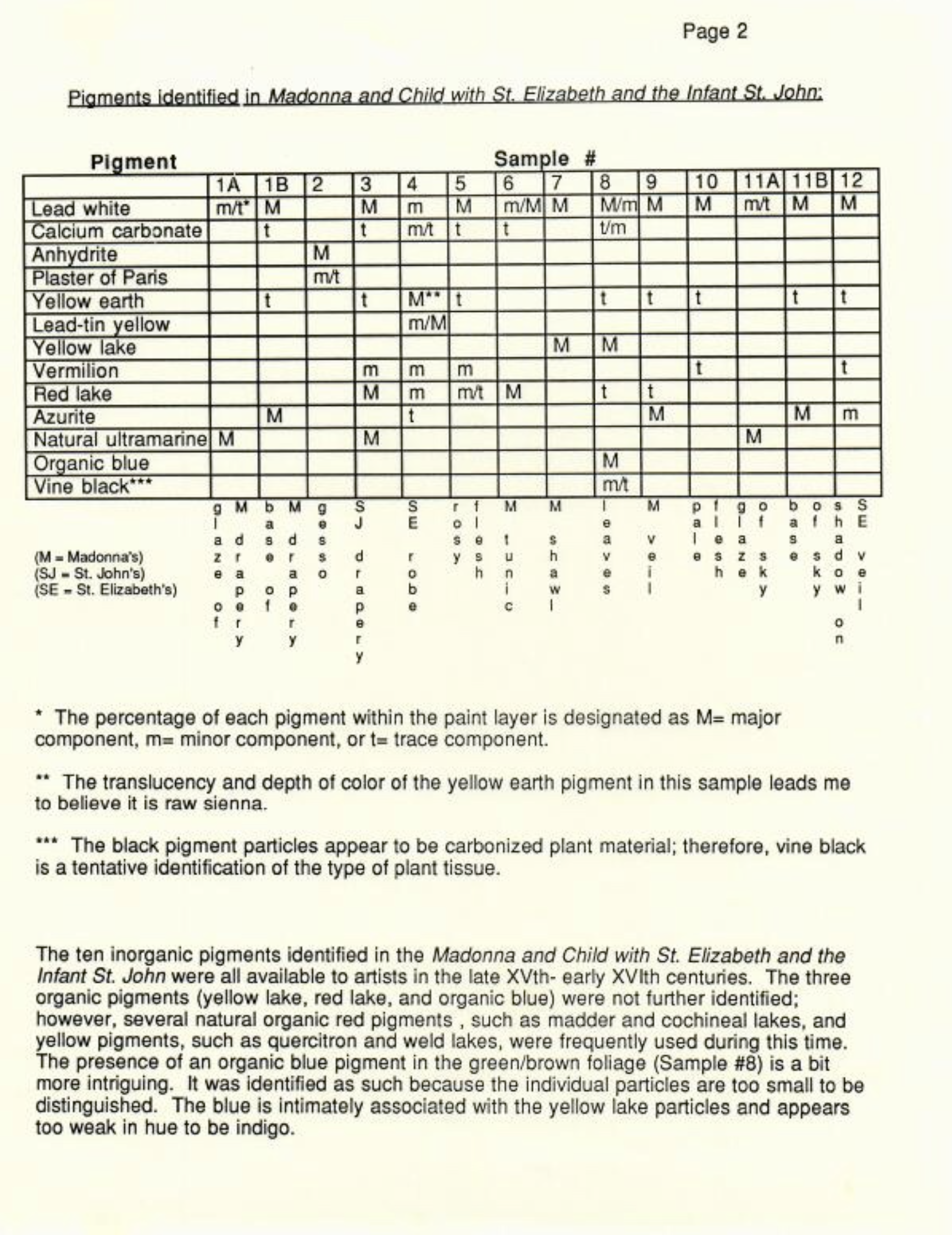
Extensive analysis has been performed by the late Dr. Walter McCrone of McCrone Research and Dr. Nazzareno Gabrielli of the Vatican Museum’s Laboratory, including layering section photomicrography and SEM/EDS analysis of twenty-four pigment samples. All findings are consistent with works of the proposed period, particularly those of Raphael of the period.
Presence of Crushed Glass in the Pigments
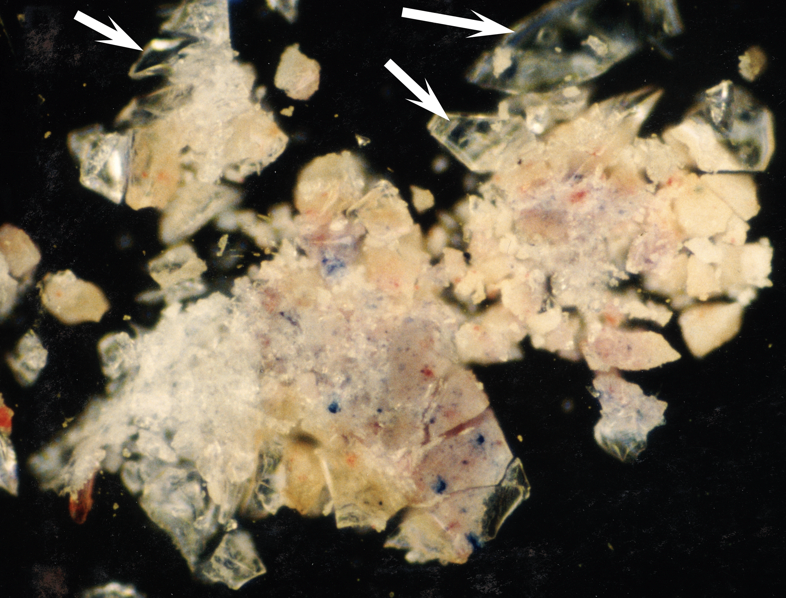
In several of the photomicrographs taken by Dr. Nazzareno Gabrielli (of the Gabinetti di Ricerche Scientificheof the Vatican Museums) of Flaget Madonna pigment samples is the presence of “… a colorless material with the particle characteristics and constitution of a manufactured glass”. The photograph above, taken by the Vatican staff, shows one such example in this pigment sample from the purple tunic of St. John. This is a terribly unusual occurrence when it is found in samples of relatively inexpensive pigments, where it was obviously not used as an extender to save costs. The same thing has been recently noted as being present in all of the early Raphael paintings in the collection of the National Gallery of Art in London, which have had pigment samples analyzed (see National Gallery Technical Bulletin, Volume 25), where Dr. Ashok Roy mentions that it may have been intended as a siccative (to accelerate the drying of the paint).
Blue of Virgin’s Robe and Sky
The blue Raphael used in the Virgin’s robe, and the sky was (invariably before 1508) a base layer of azurite and lead-white with a ‘wet-in-wet glaze’ of natural ultramarine and lead-white, occasionally with additions. This combination is said to have been “peculiar” to the Flemish, Venetians, Francesco Francia, Perugino (Raphael’s teacher), and Raphael (particularly in his pre-Roman works).
It should also be noted that Raphael would use the exact same combination of blue that he used in the Virgin’s robe in the sky, albeit not as finely ground. This varies from the typical practice of using a lesser, cheaper variety of blue in the sky. Even in such exceptional instances, where Raphael included verdigris in the Virgin’s robe, he also had the same green in the sky (as in the Madonna of the Meadow). In the Flaget Madonna, we find trace amounts of yellow earth in both base coats of the blues just mentioned, an unusual color to include in a sky, yet consistent with Raphael’s practice and keeping with the “harmony of tone” he is known for.
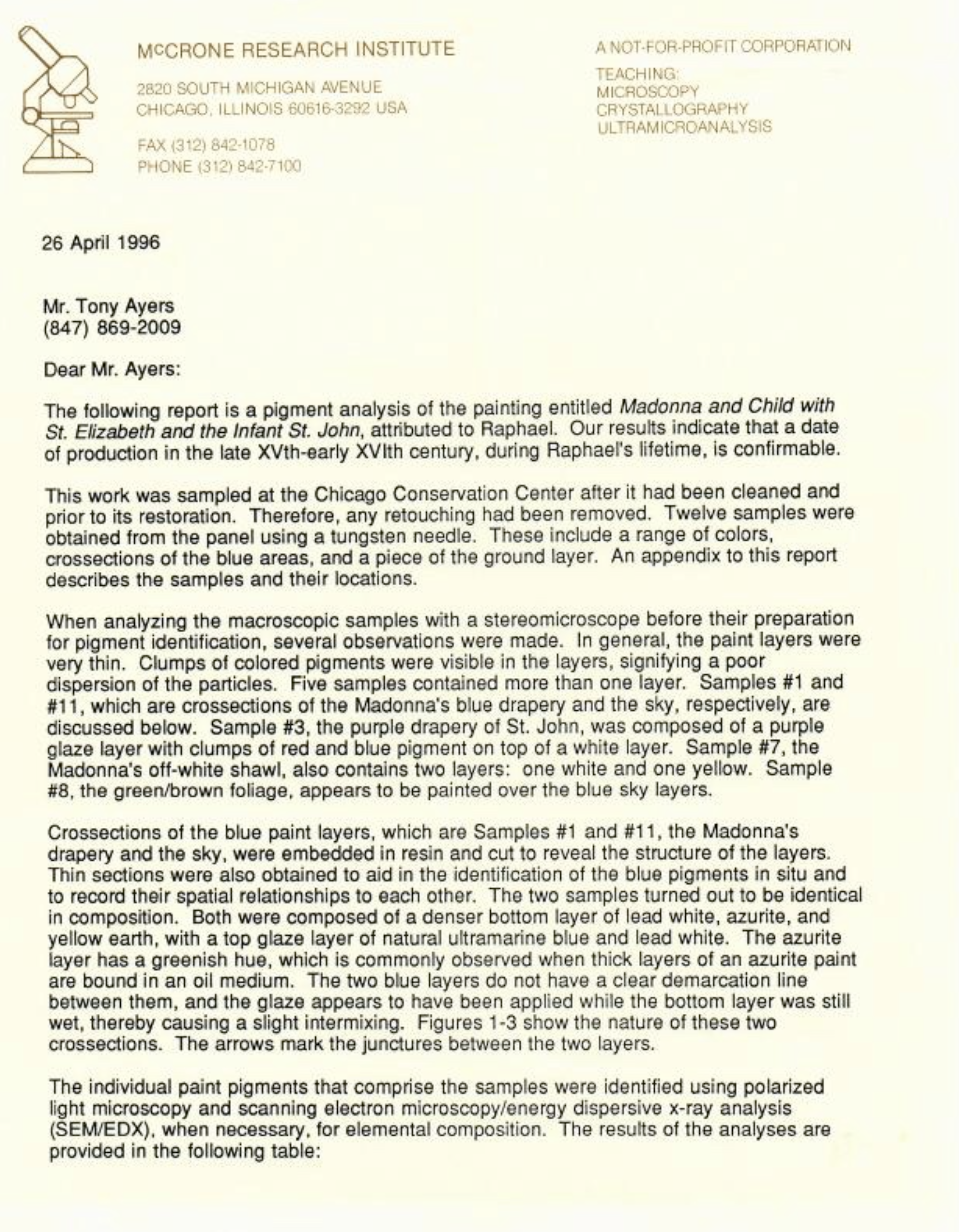
The blues (Virgin’s robe and sky) of the Flaget Madonna have been positively identified (by Dr. Walter McCrone) using layering section photomicroscopy and SEM-EDS analysis as being the same as the unusual one described above.
Terra Verde present in the flesh
Dr. Nazzareno Gabrielli found a pigment present that he considered unusual and notable in an oil medium, the presence of terra verde in one of the four samples of flesh tones he analyzed, that sample being flesh in the shadow of one face. This may be why he believes the painting to be very early in date, dating from the late 15th c. or very early into the 16th c. from a scientific standpoint. Earlier in using oil mediums, it was discovered that terra verde did not respond well to mixing with the oil. Its use was rapidly curtailed when using the medium, except for isolated retro usage quite a bit later. This indicates the artist may have been familiar with tempera and possibly fresco painting techniques. It is known that Raphael had, in isolated instances, used terra verde in small areas of the flesh, and in particular in the shadow areas of the faces, as we see in the Flaget Madonna. Ironically, Dr. Gabrielli’s predecessor, Fabrizio Manchinelli, noted precisely the same thing in his 1983 article on one of the Vatican’s panel paintings by Raphael.
Pink undertone in the sky
The Flaget Madonna has a pink undertone in the lower regions of the sky, developed through an admixture of red lake, as was typical of Raphael.
McCrone Research Institute


Physical Testing
Ground
The ground of the Flaget Madonna is composed of anhydrite.
A notable item in x-radiographs of the Flaget Madonna is the presence of scattered pockets of small white dots throughout. These result from poorly mixed gesso leaving air pockets, which are filled with x-ray dense lead-white during the priming process. All x-radiographs of early Raphael panel paintings examined to show the same thing, and many authorities have noted this characteristic.'
Examination of the x-radiographs of the Saint Catherine of Alexandria, Saint John the Baptist Preaching, the Ansidei Madonna, and An Allegory (Vision of a Knight) at the National Gallery in London show the same characteristics mentioned.
Medium
The Flaget Madonna is painted exclusively with an oil medium, evident in the green caste of the azurite. It appears to include very isolated usage of tempera (visually identified by Dr. McCrone). Oil on the panel was used during the late-fifteenth to the mid-sixteenth centuries. Raphael's early artistic career coincided with the increase in the use of oil paint in Italy, and most of his earlier works on panel used oil.
Panel Construction
Fortunately, the Flaget Madonna’s panel has never been thinned and remains relatively flat. Some have suggested it has been narrowed slightly, although one can not be sure. The panel is consistent with known panels of Raphael, even down to; the shape and dimensions of the two horizontal keyed inset battens (actually to the millimeter), construction, species, and overall dimensions. The back of the Flaget Madonna is remarkably similar to several photographs of panels of known Raphael in the Princeton Raphael Symposium. The back of the Bindo Altoviti (before transfer) is the spitting image of the Flaget Madonna, even down to the battens' proportions and positions (minus the butterfly repair on the former). The species identification, Abies (True Fir) for the battens and Populus (Poplar) for the panel, was performed by the Center for Wood Anatomy Research, U.S. Forest Products Laboratory, Madison, Wisconsin, and is consistent with what one would expect of an early Italian panel painting and used by Raphael.
Dr. Nicholas Eastaugh - Director, Art Analysis & Research (AA&R)
Nicholas Eastaugh is the founder and director of Art Analysis & Research. He originally trained as a physicist before studying conservation and art history at the Courtauld Institute of Art, London, where he completed a Ph.D. in scientific analysis and documentary research of historical pigments in 1988.
Since 1989 he has been a consultant in the scientific and art technological study of paint and paintings. He is a frequent lecturer and a Visiting Research Fellow at the University of Oxford. In 1999 he co-founded the Pigmentum Project, an interdisciplinary research group developing comprehensive, high-quality documentary and analytical data on historical pigments and other artists' materials.
AA&R objectively evaluated the Flaget Madonna through a methodology called analysis of competing hypotheses. They systematically created a social network of artists from 15th and 16th century Florence, Italy, to establish all potential candidates. They then identified scientifically measurable artistic practices, such as the use of critical pigments, the presence of underdrawings, and types of bindings or other materials used, to create a substantial data set for each candidate.
AA&R's report confirmed the use of orpiment in the Flaget Madonna painting, a pigment used by a very small group of Italian Renaissance artists, including Raphael, Leonardo, and Michelangelo.
Goldfinch
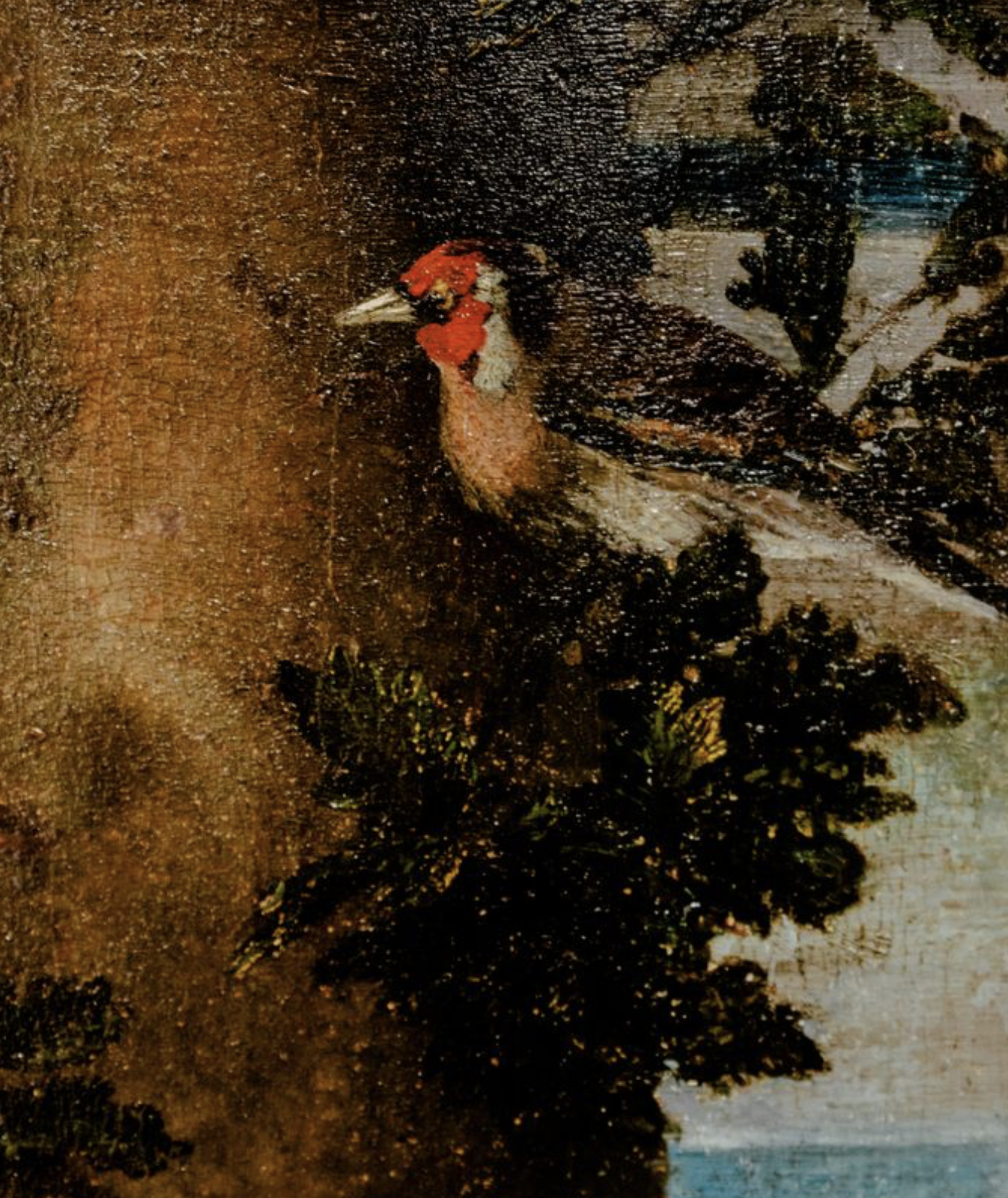
The information in the section about the goldfinch and its iconographic meanings, particularly its use in the Italian Renaissance artworks section, comes from Herbert Friedmann’s book The Symbolic Goldfinch.
The most frequent meaning of the goldfinch is the ‘Passion of Christ.’ This is watered down somewhat in the Flaget Madonna because its location has been removed from the holy personages, particularly from the Christ Child, adding more importance to its ancillary meanings.
The location of the goldfinch in the Flaget Madonna (perched on a branch of the oak tree behind the Virgin) is extraordinarily unusual. It indicates the painting was intended for a patron from a religiously conservative region, such as Urbino. This is because, in these areas, unlike Florence, it was considered inappropriate to request the direct intervention of a holy personage in times of illness/plague; instead, believers were supposed to supplicate themselves to the will of God. Therefore the symbolic goldfinch was pulled away from the central characters. In his work, Herbert Friedmann examines the 486 devotional paintings (later Middle Ages through Baroque, and primarily Italian in origin). He notes the goldfinch being “unattached” from the personages on only approximately 34 occasions. He states it is only four times in trees (in works by Crivelli, Francia, Pisanello, and Simone Martini). This unusual location compositionally is what one would expect if the painting were, as believed, intended for the Della Rovere, particularly considering the tree it is perched in is an oak (rovere) tree. The goldfinch is also thought to relate to the papacy because the coloration corresponds somewhat to the papal tiara. This would be relative to the Della Rovere, in that, at the proposed time frame of the Flaget Madonna, the reigning Pope was Julius II della Rovere, the uncle of Francesca Maria della Rovere. Nothing would be more appropriate than the proud family including a symbol of their power by representing the Papacy with an iconographic symbol.
Another of the meanings associated with the goldfinch is Fertility; again, appropriate to the Della Rovere, for Guidobaldo adopted Francesca Maria because the Duke and Duchess could not produce offspring. Fertility also relates to the goldfinch’s frequent use in wedding pictures, which could tell Francesca Maria that he became active in c.1504 (married c.1508). Contemporary documents reveal that the Prefettessa Giovanna Feltria della Rovere commissioned a Madonna from Raphael at this time. The iconography in the Flaget Madonna is precisely what one would expect of a wedding picture in general and one for the Della Rovere in particular.
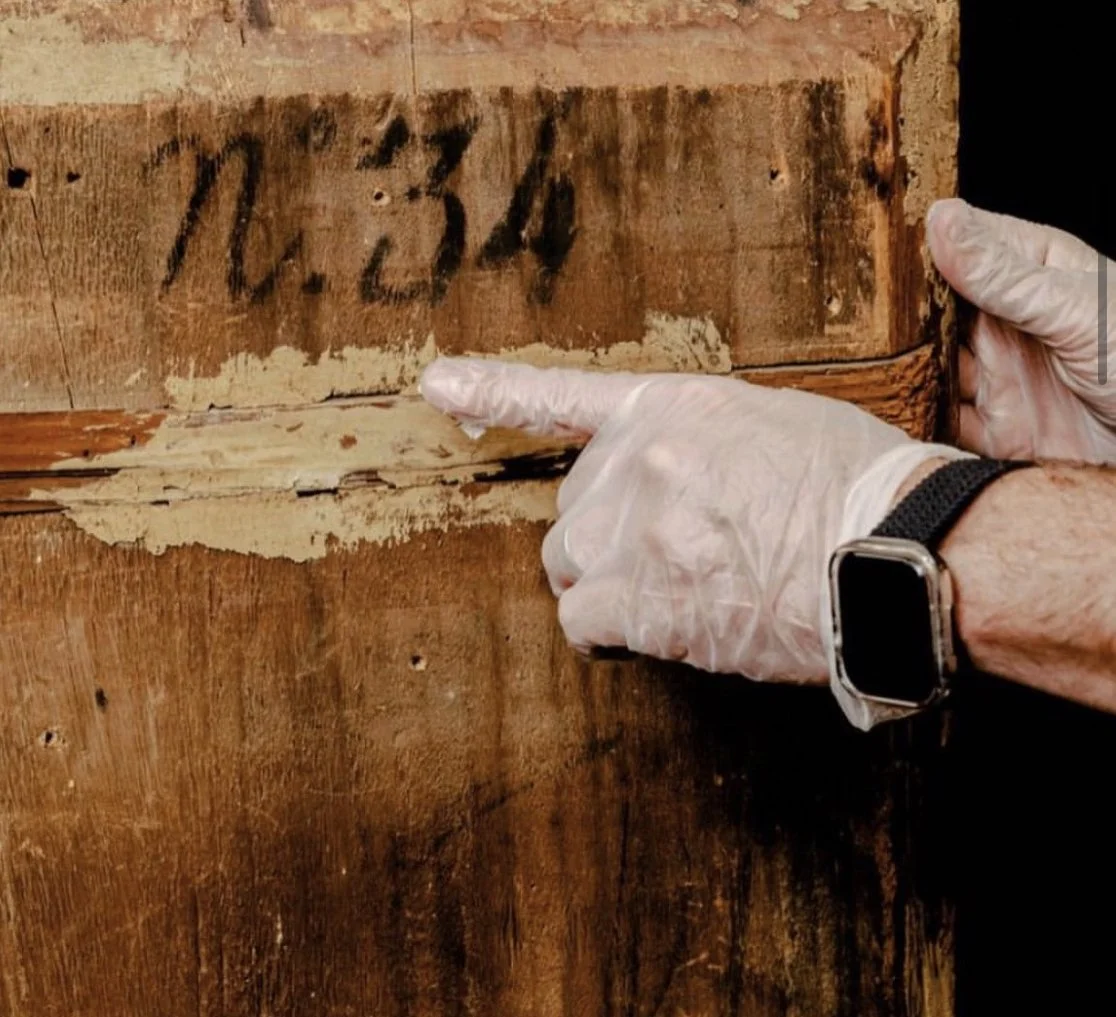
The Flaget Madonna reveals an inventory marking on the back of the wood panel. It is a large number, “34” in black paint, now much faded (although the photographs show it as much darker than in person). The inventory from where this number came has not yet been identified. The style of lettering indicates the entry may date from the eighteenth or early into the nineteenth century.
Stylistic Characteristics
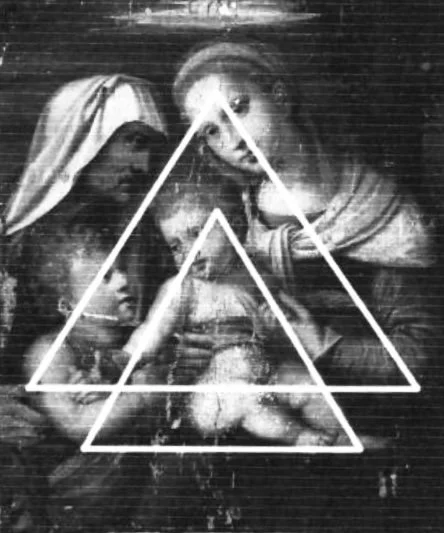
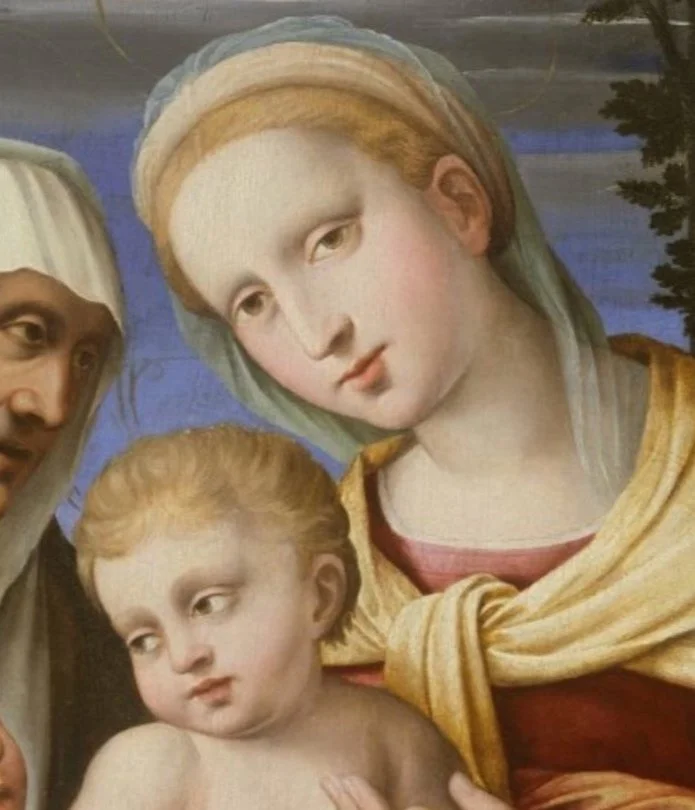
Many peculiarities of style are present in the Flaget Madonna, all of which are present in the youthful works of Raphael. They are not the type of pastiche one would associate with a copyist, but, instead, indicate the result of an artist assimilating new ideas into their already diverse repertoire. Pentimenti in the Flaget Madonna indicate the probability that it is an original by the master rather than a copy. Remnants of the influences of Giovanni Santi, Timoteo Viti, and Perugino are certainly to be felt and expected, given their relationships with Raphael. Early influences of Leonardo are present in the outstretched hand of Christ (a reverse of Leonardo’s Adoration of the Magi) and the equilateral triangular composition, as are in the works of Fra Bartolommeo.